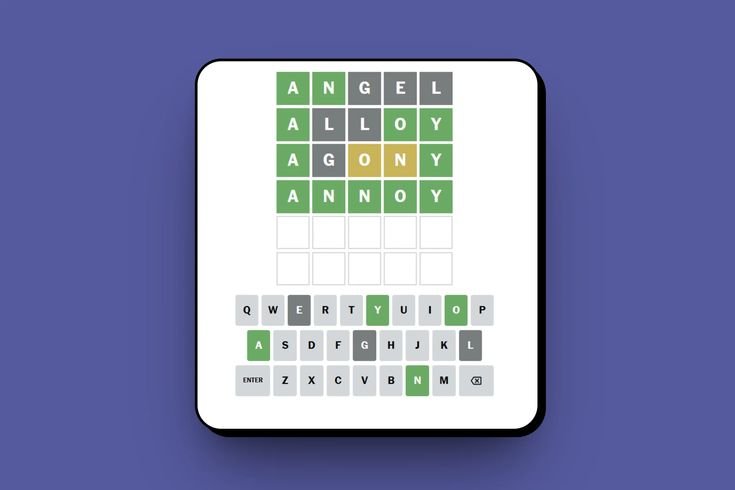
Nerdle, the mathematical sibling of Wordle, has captured the attention of puzzle enthusiasts who enjoy flexing their numeracy skills. While both games share a similar structure of deduction and iterative guessing, Nerdle presents a unique set of challenges that can make it feel significantly harder than its word-based counterpart.
This article why Nerdle is Harder than Wordle delves into the intricacies of Nerdle, comparing it to Wordle, exploring the appeal it holds for math lovers, and ultimately dissecting why solving Nerdle puzzles can be a truly brain-bending experience.
Understanding Nerdle and Wordle
What is Nerdle?
Nerdle is a math game that, like Wordle, challenges players to guess a secret word, only in this game the “word” is a short arithmetic sentence, such as “1+2+7=10”. The correct answer is always eight characters long, comprising numerical digits and arithmetic symbols – plus, minus, multiply, divide, and the equals sign.
Players get six tries to solve the mathematical equation, mirroring Wordle’s format. The objective is to find the correct sum of the day, employing the same digits and operators one would find on a calculator. The crucial element is that the equation must be mathematically valid, adhering to standard arithmetic principles. Each guess provides clues, guiding the player closer to the correct solution.
Comparing Nerdle and Wordle
Some might argue that provided one possesses decent numeracy comprehension, Nerdle is easier than Wordle. This perspective stems from the fact that there are fewer characters to whittle down – only 10 numbers and 5 arithmetic symbols compared to the 26 letters in Wordle. The equals sign will also be placed somewhere near the end of the calculation.
Furthermore, the _Nerdle_ database holds 17,723 puzzles, a stark contrast to _Wordle’s_ comparatively small answer bank of approximately 2,500 possibilities. However, the order of operations introduces a layer of complexity that Wordle simply doesn’t have.
Despite fewer characters, the possibilities explode when considering the placement and combination of operators. Often, commutative answers, where the order of addends can change without affecting the sum, add to the tricky nature of the puzzle.
The Appeal for Math Lovers
Nerdle appeals to a specific segment of puzzle enthusiasts: math lovers. It takes the well-worn formula popularized by Wordle and applies it to numbers, offering a fresh and stimulating challenge for those who relish mathematical thinking. For individuals who enjoy number puzzles and problem-solving that demands precise calculation and logical deduction,
Nerdle presents an engaging alternative. The satisfaction of cracking a particularly complex Nerdle puzzle, arriving at the correct solution through careful consideration of mathematical rules and relationships, is a unique reward that resonates deeply with those who appreciate the elegance and precision of mathematics.
The Mechanics of the Nerdle Puzzle
How to Solve a Nerdle Equation
In the realm of Nerdle, solving a mathematical puzzle requires a structured approach. You have six attempts to guess the daily answer, with each attempt offering valuable hints. The game provides feedback by coloring the characters in your guess, and these colors indicate the following:
- Black characters are not part of the correct sum, meaning they are entirely incorrect.
- Red characters exist within the sum but are misplaced, signaling a need for positional adjustment.
- Green characters are correctly positioned, confirming their place in the equation.
The correct answer is mathematical, which means that to correctly solve the puzzle you will need to use BODMAS in order to complete it.
Understanding the Number Format
Understanding the formatting of a Nerdle puzzle is crucial to effectively solve the problem. The rules dictate that each Nerdle equation comprises eight “letters,” where a “letter” can be:
- Any of the digits from 0 to 9.
- Any of the arithmetic operators +, -, *, /, and the equals sign (=).
The “word” must represent a valid mathematical calculation, and crucially, it must contain one equals sign. The number on the right side of the equals sign represents the result of the calculation and must be a single, valid number, not another calculation. Standard order of operations, often remembered by the acronym BODMAS (Brackets, Orders, Division and Multiplication, Addition and Subtraction), is in effect, meaning multiplication and division are resolved before addition and subtraction.
This is the kind of math game that requires focus and precise thinking. The order in which these elements are arranged is important, as each has an impact on the answer.
Strategies for Your First Try
When tackling a Nerdle puzzle, a strategic approach to your first try can significantly impact your chances of success. Since a small number of hints can be provided, thinking through your first try is essential. A good strategy involves trying sums that incorporate both plus and minus signs, offering a broader range of arithmetic exploration.
Equations involving division followed by multiplication can also prove insightful. These combinations help test various operator placements and their effects on the outcome. This approach gives an initial overview of which numbers and symbols are part of the correct solution. Remember that the ultimate goal of the solver is to arrive at the correct answer. Consider also using commutative answers like “2+3” and “3+2”. These provide more information if the operator is correct.
Challenges in Nerdle Compared to Wordle
The Complexity of Mathematical Equations
One of the main reasons why Nerdle is harder than Wordle is the complexity of mathematical equations. In Wordle, you’re dealing with letters and forming words, which, while requiring a good vocabulary and pattern recognition, doesn’t involve strict rules like the order of operations. In contrast, Nerdle demands that every guess be a mathematically valid equation.
The correct solution must adhere to the rules of arithmetic, such as BODMAS (Brackets, Orders, Division and Multiplication, Addition and Subtraction). Nerdle doesn’t use leading zeros or lone zeros, even though some may be accepted as valid guesses. Also, Nerdle doesn’t use negative numbers, even though some may be accepted as valid guesses. This adds a layer of difficulty as players must consider the placement of operators and digits to form a mathematical equation that is not only syntactically correct but also numerically accurate.
Common Pitfalls for New Players
New players often stumble upon common pitfalls when transitioning to Nerdle. The primary issue is overlooking the order of operations. Unlike Wordle, where the sequence of letters is relatively straightforward, Nerdle requires you to account for BODMAS or a similar order of operations convention.
This means that even if all the digits and operators are present in the guess, the equation may still be wrong if the operators are not arranged to yield the correct answer. While 0 cannot appear by itself on the left-hand side, it is allowed to appear as the answer on the right-hand side, although negative numbers are not allowed on either side. The prohibition against negative numbers extends to all sequences of consecutive operators. This requires careful planning to solve the puzzle and makes it harder than Wordle.
Why Nerdle Requires More Logical Thinking
Nerdle demands a greater degree of logical thinking than Wordle because it integrates mathematics into the puzzle-solving process. Wordle leans heavily on vocabulary and pattern recognition, while Nerdle necessitates the application of mathematical principles. You must evaluate each guess not only for the presence of correct digits and operators but also for their placement in a way that yields a valid and correct calculation.
This entails logically deducing the correct placement based on the results of previous guesses. This extra layer of analysis is what makes Nerdle uniquely challenging, as it calls upon logical reasoning in addition to linguistic intuition. The solver must think through the possibilities, assessing the viability of each mathematical solution. Thus, the mathematical equation must be solved carefully.
Tips for Mastering Nerdle
Using a Nerdle Solver
Leveraging a Nerdle solver can be a useful tool in mastering the game. A Nerdle solver can assist in refining your guesses by providing insights into potential solutions. Such a tool typically functions by taking in your previous guesses and their corresponding feedback, that is, which digits and operators are correct and in the right place. Based on this information, the solver will suggest possible next guesses that align with the constraints you’ve uncovered. A simple interactive Python program tells you what guesses to make and lets you report what grade you’ve gotten from the web interface. While relying solely on a solver might detract from the personal satisfaction of cracking the puzzle independently, it can significantly accelerate your learning process and help you understand the underlying logic of the game.
Practicing with Different Math Games
One effective strategy for improving your Nerdle skills is to engage with a variety of math games. By practicing with different types of mathematical puzzles, you can strengthen your overall numeracy skills and develop a more intuitive understanding of mathematical relationships.
This might include games that focus on mental arithmetic, equation solving, or mathematical logic. Regular engagement with such math games can enhance your ability to quickly assess potential Nerdle solutions and make more informed guesses. If you do get the answer right, then you will be presented with an option to share your results in one of those social-media friendly grids. There is a hard mode option of sorts, as you can head into Nerdle’s settings and deactivate commutative answers.
Building Mathematical Intuition
Building mathematical intuition is key to mastering Nerdle. Intuition, in this context, refers to the ability to quickly and accurately assess the plausibility of a mathematical equation without having to perform extensive calculations. This involves recognizing patterns, understanding the relative magnitudes of numbers, and developing a sense of how different operators interact.
The more you play Nerdle and engage with other math games, the stronger your mathematical intuition will become. This enhanced intuition will allow you to generate more informed guesses, identify potential solutions more efficiently, and ultimately solve Nerdle puzzles with greater speed and accuracy. It is important to understand arithmetic, like with a math game, to easily find the correct answer.
Conclusion
In conclusion, while both Wordle and Nerdle offer engaging daily puzzle challenges, Nerdle presents a steeper learning curve due to its mathematical nature. The necessity to form valid mathematical equations involving operators, digits, and the equals sign, while adhering to the order of operations such as BODMAS, adds layers of complexity absent in Wordle.
Although there are often fewer possibilities to contend with compared to Wordle’s word-based guesses, finding the correct solution in Nerdle requires more strategic thinking, making it a particularly rewarding math game for those who enjoy the thrill of solving complex mathematical problems. This makes Nerdle the hardest one of the two games to solve.
FAQS
Q1. Is Nerdle harder than Wordle?
Yes, Nerdle is generally harder than Wordle because it requires solving valid mathematical equations rather than guessing words. Players must apply arithmetic logic, which makes finding valid guesses more challenging, especially for those less comfortable with math.
Q2. How difficult is Nerdle?
Nerdle’s difficulty depends on a player’s math skills. It is considered harder than Wordle because every guess must be a correct equation that follows order of operations. Strong knowledge of BODMAS makes solving the puzzle easier.
Q3. Is there an easier version of Wordle?
Yes, several Wordle alternatives offer easier gameplay by providing hints, extra attempts, or unlimited practice modes. These versions are ideal for beginners or players who want a relaxed puzzle experience.
Q4. What do Nerdle answers never include?
Nerdle answers never include negative numbers, leading zeros, or invalid operator sequences. Understanding these rules helps players eliminate impossible solutions and solve puzzles more efficiently.
Q5. Addicted to Wordle?
If you enjoy Wordle, similar daily puzzle games like Nerdle offer a fresh challenge. Nerdle focuses on arithmetic and logical thinking, making it a great option for players who enjoy number-based puzzles and problem solving.
Addicted to ‘Wordle’? You Might Want To Try These Word Puzzles